Working with test cases
The steps below describe the Windows application. For browser-based test-library editing, variants, quick cases and requirement links, see Maintain test cases and requirements in the browser.
Test cases grouped within test units define the tests that are available within a project.
A test case describes the prerequisites that must be fulfilled in order to perform the test, the test steps that must be performed during testing and the expected results of the completed tests.
A test case can contain multiple attachments, e.g. a Microsoft Office Excel document that describes how the software to be tested should behave (i.e. in this example, that the application to test generates Microsoft Office Excel documents by itself).
Note
The dialog window for editing test cases is non-modal, i.e. you can keep the dialog window open and still continue working with other parts of Zeta Test. This is helpful when you e.g. want to display multiple information concurrently.
Creating and editing test cases
In order to create a test case, follow these steps:
- Select a test unit in the structure view.
- Right-click the test unit.
- Select "New test case" from the context menu.
- The dialog window "Edit test case" shows up. Fill out all required fields.
- Confirm by clicking "OK".
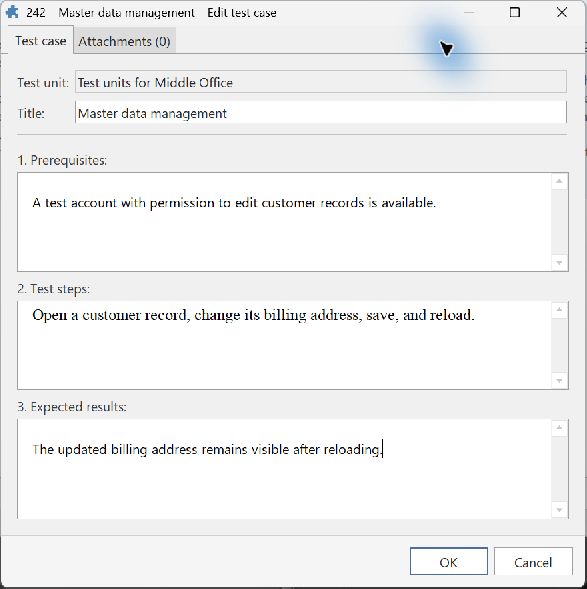
Follow the following similar steps to edit an existing test case:
- Right click the test case to edit.
- Select "Edit test case" from the context menu.
- The dialog window "Edit test case" shows up. Fill out all required fields.
- Confirm by clicking "OK".
Note
If planned test cases exist that are assigned to a test case (within the respective test plans), the changes to a test case do not automatically change the planned test cases, too. You will need to perform this action manually. To do this, open the "Edit test plan" dialog window, select the "More settings" tab and click on the "Synchronize test case modifications" button.
Importing test cases
You can import test cases from other projects:
- Right click "Test units" in the structure view of the main window.
- Select "Import test units and cases" from the context menu.
- Follow the instructions in the wizard dialog that appears.
Test cases that you imported into a project still exist in the original project from which they were imported without any changes to them.
You can also import test cases from Excel, including quick test cases with multiple rows.
Dependent test cases
Enable dependent test cases in project settings to show the dependency page in the test-case editor. Add the cases that the current test depends on. Dependencies appear in the case overview and during test execution.
Availability
From version 6.0.7, dependencies can control result entry. Existing relationships remain informational links initially.
Choose an Execution rule for each dependency:
- Hint only displays the relationship. This is the default for existing and new relationships.
- Must succeed requires a successful predecessor result before recording a dependent result.
- Must not fail accepts successful and partially successful results. An untested predecessor still blocks result entry.
Use the existing synchronization action to transfer library changes to the test plan. A new test run captures that planned state. All mandatory predecessors must exist in the same run and satisfy their rule with all their variants.
A blocked test remains readable in Windows and Web. The notice identifies the unmet prerequisite and links to the predecessor. Check the prerequisites again after testing it.
If a predecessor result changes later, existing dependent evidence is retained and marked Retest required. Once the predecessor satisfies its rule again, repeat the dependent test. If the recorded result is still correct, use the explicit confirmation button to confirm the retest.